Why Technical Fabric Smells Faster: Questions Answered
Quick Answer: Polyester and nylon are oleophilic - they attract and hold oils, including the skin oils that odour-causing bacteria feed on. Cotton is hydrophilic and holds water instead, which washes out easily. So the same wash cycle that cleans a cotton shirt leaves the oil-bound residue in a synthetic one, and the smell returns the moment you warm up. The fixes are a proper technical detergent, cooler and longer washes, no fabric softener ever, and an occasional vinegar or oxygen-bleach soak.
It came out of the wash smelling fine.
Twenty minutes into the walk it smelled like last Tuesday.
The wash removed the water. It did not remove what the smell was living in.

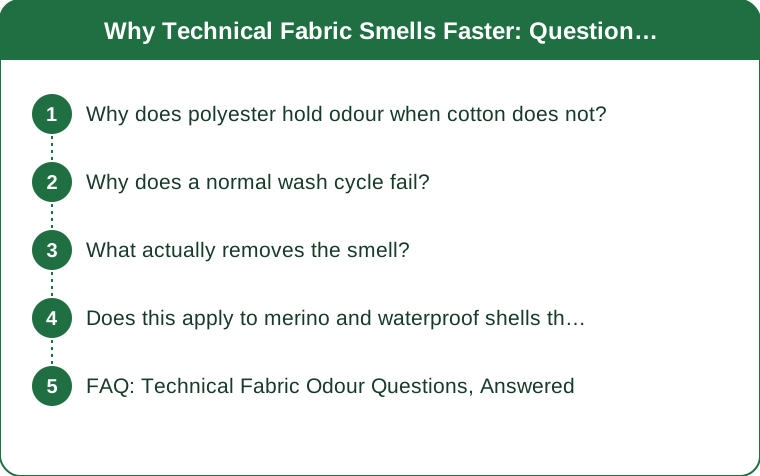
Why does polyester hold odour when cotton does not?
Because of what each fibre attracts at a molecular level.
Polyester and nylon are oleophilic - oil-loving. Their surface chemistry attracts and binds lipids, which includes sebum from your skin. Cotton is hydrophilic - water-loving - and absorbs water readily while repelling oil comparatively well.
This matters because odour is not caused by sweat. Fresh sweat is essentially odourless. The smell comes from bacteria metabolising the compounds in sweat and skin oil, producing volatile fatty acids and sulphur compounds. No oil residue, no food source, no smell.
So the sequence in a synthetic garment is:
- Skin oil transfers to the fabric during wear and binds to the fibre
- A normal wash cycle removes water-soluble soil and leaves much of the oil
- Bacteria colonise the remaining residue
- Body heat and moisture on the next wear reactivate the whole process within minutes
Which explains the specific and infuriating pattern: the garment smells clean when cool and dry, and smells immediately when warm and damp. The odour compounds are still there, waiting for the conditions to volatilise.
Two more factors make technical gear worse than ordinary synthetics. Tightly knit performance fabric has enormous surface area relative to its weight, which means more binding sites. And antimicrobial finishes - silver-based treatments and similar - wear off after 20 to 50 washes, at which point the garment often smells worse than an untreated one because the bacterial community that recolonises is less balanced.
Why does a normal wash cycle fail?
Because standard detergent, cold water and a short cycle are optimised for a different kind of soil.
Ordinary detergent contains surfactants that work well on water-soluble soil and reasonably on light oils. Deeply bound sebum in a tight synthetic knit needs longer contact time and more targeted chemistry than a 30-minute cool cycle delivers.
The specific ways a normal wash goes wrong:
- Overloading. Fabric needs to move freely for mechanical action to work. A packed drum means the middle of the load barely gets agitated
- Too much detergent. Counterintuitive but real - excess detergent does not rinse out and leaves residue that traps odour compounds
- Fabric softener. The single worst thing you can do to technical fabric. It deposits a lubricating film that clogs the fibre structure, blocks wicking, and gives bacteria a substrate to live on
- Washing inside out, or rather not doing so. The oil is on the inside surface, so that is the side that needs the water
On fabric softener and dryer sheets specifically: the residue is cumulative. A garment washed with softener for a year has a build-up that no single wash removes, and the odour problem gets progressively worse rather than staying constant. Stopping is necessary; a stripping wash is what actually resets it.
Temperature is a genuine trade-off. Warmer water dissolves oil better - but most technical fabrics and any waterproof membrane have temperature limits, typically 30 or 40 degrees. Exceeding them damages laminates, tapes and DWR finishes. The answer is longer contact time at the permitted temperature, not hotter water.

What actually removes the smell?
A proper technical detergent for maintenance, and an occasional soak for a reset.
For routine washing:
- Use a detergent formulated for technical fabric. These are enzyme-and-surfactant systems designed for oil in synthetics, and they genuinely outperform ordinary liquid detergent on this specific problem
- Use about half what the bottle suggests. Residue is part of the problem
- Wash inside out, since the oil is on the inner surface
- Fill the drum to about two-thirds so garments can move
- Add an extra rinse cycle - the most underused setting on any machine
- Wash promptly, not three days later in a gym bag, since bacterial load compounds
For a garment that already smells:
- Soak in a solution of one part white vinegar to four parts cool water for 30 to 60 minutes. Vinegar breaks down the alkaline residues that odour compounds bind to
- Or use an oxygen bleach soak - sodium percarbonate, dissolved in warm water, for a few hours. Effective, and colour-safe unlike chlorine bleach
- Then wash normally with technical detergent and an extra rinse
- Air dry completely. Any residual damp restarts the bacterial process immediately
Sports-specific odour-eliminating additives - the enzyme-based ones sold for exactly this - work well and are worth having for kit that gets heavy use.
Do not use chlorine bleach on technical fabric. It degrades elastane and damages membranes and coatings, and it does not solve the oil problem anyway.
And the habit that prevents most of it: air the garment immediately after wearing. Hanging a shell or base layer in moving air for an hour before it goes in a bag or basket dramatically reduces the bacterial load that builds while it sits damp.
Does this apply to merino and waterproof shells the same way?
No - merino is a genuine exception, and shells have an extra constraint.
Merino wool resists odour for real reasons, not marketing ones. The fibre has a complex structure that absorbs moisture into its core rather than holding it on the surface, which limits the surface moisture bacteria need. Wool’s natural lanolin residue and its surface chemistry are also less hospitable. In practice a merino base layer can be worn for several days without developing the smell a polyester one develops in one.
The cost is durability and price. Merino is weaker and wears faster than polyester, which is why blends - 60% merino with a nylon core - are common and represent a genuine compromise rather than a downgrade.
Waterproof shells need a different approach entirely:
- The membrane has temperature limits - usually 30 or 40 degrees - and exceeding them delaminates it
- Regular detergent leaves residue that attracts water and makes a shell wet out, which feels like the waterproofing has failed when it has not
- A dedicated technical wash is genuinely necessary here, not optional
- Tumble drying on low or a warm iron reactivates the DWR finish, which is one of the few times heat helps
On the specific problem of a shell that smells: the odour is usually in the inner liner rather than the membrane. Turning it inside out and treating the liner directly is more effective than washing the whole thing more aggressively.
Down insulation is its own category. Down absorbs oil readily and clumps when wet, so it needs a down-specific wash, thorough rinsing, and tumble drying with dryer balls to restore loft. This is a two to three hour process and it cannot be rushed.
And for anything with a waterproof-breathable membrane: never dry clean. The solvents damage the laminate.
FAQ: Technical Fabric Odour Questions, Answered
Why does my jacket only smell when I warm up?
The odour compounds are bound to oil residue in the fibre and only volatilise when warm and damp. When the garment is cool and dry they stay put, which is why it passes the sniff test in the wardrobe and fails within twenty minutes of walking.
Is fabric softener really that bad?
Yes, on technical fabric specifically. It deposits a lubricating film that blocks wicking, reduces breathability and gives bacteria a residue to live in. The effect is cumulative, so a garment washed with softener for a year needs a stripping soak rather than one careful wash.
What temperature should I wash technical gear at?
Whatever the care label permits, usually 30 or 40 degrees, and no higher - membranes, tapes and elastic all degrade above their limits. Compensate with longer contact time and a proper technical detergent rather than heat.
Does vinegar actually work?
Yes, as a soak rather than as a detergent. One part white vinegar to four parts cool water for 30 to 60 minutes breaks down the alkaline residue that odour compounds bind to. Follow it with a normal wash and an extra rinse.
Why does merino not do this?
Merino absorbs moisture into the fibre core rather than holding it at the surface, which limits what bacteria have to work with, and its surface chemistry is less hospitable to them. The trade-off is lower durability, which is why merino-nylon blends are so common.
Can I use regular detergent occasionally?
Occasionally is fine and it will not ruin anything. As a routine it under-cleans oil in synthetics and leaves residue, which is the mechanism behind the smell returning. Half a dose of technical detergent plus an extra rinse is the better default.
TL;DR:
- Polyester and nylon attract oil; odour bacteria feed on that oil, and a normal wash leaves it behind
- Fresh sweat is odourless - the smell is bacterial metabolism of skin oil bound to the fibre
- Never use fabric softener or dryer sheets on technical fabric; the residue is cumulative
- Use technical detergent at half dose, wash inside out, two-thirds full drum, extra rinse
- For an already-smelly garment: vinegar soak or oxygen bleach, then wash and dry fully
- Merino genuinely resists odour; shells need a technical wash and low heat to restore DWR
- Air garments in moving air straight after wearing - it prevents most of the problem
The wash removed the water. The oil is what you actually needed to get out.
Keep Reading
This article is for general informational and styling purposes only. Fit, sizing, and product availability may vary.