Is Gorpcore Still Wearable in Late Summer Heat?
Quick Answer: Yes, but not through outerwear. Gorpcore in late summer works by moving the technical signal from the jacket to the accessories and the details - webbing, buckles, ripstop, cord locks, a technical bag, trail-shaped footwear - while the actual clothing on your body stays as light as any other summer outfit. The mistake is trying to wear the same pieces in August that define the look in October. The aesthetic is about utility signals, and utility signals do not have to be warm.
Gorpcore is an autumn and winter aesthetic by construction. Its defining pieces - the shell, the fleece, the puffer vest - are all insulating or wind-blocking, and none of them belong on an 85F afternoon.
So the late-August question is a real one: is there a version of this that is not just heat with extra steps?

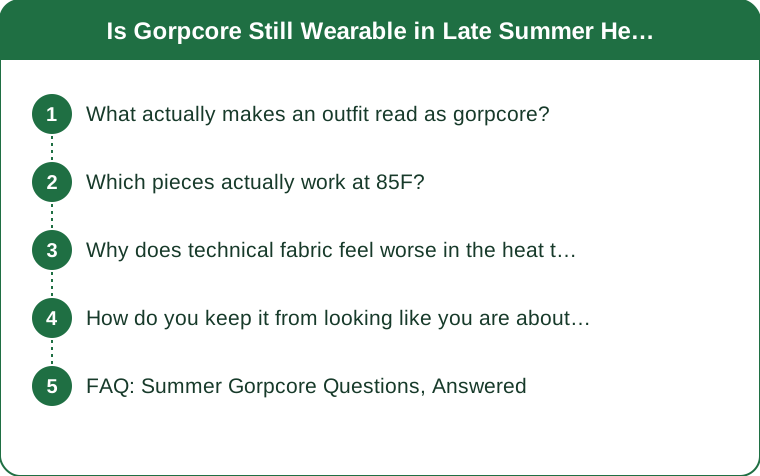
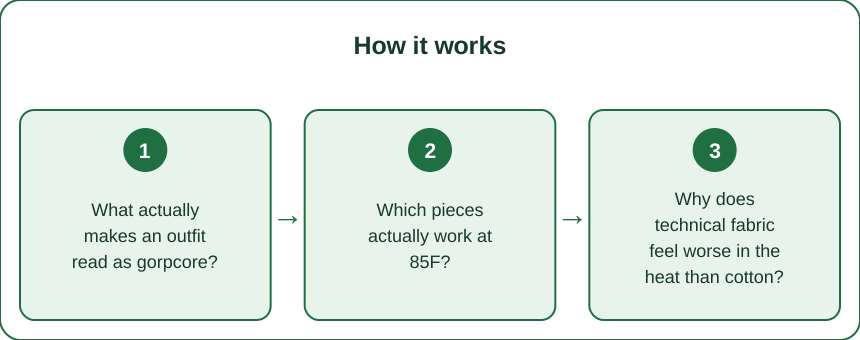
What actually makes an outfit read as gorpcore?
Utility signals, not warmth.
Break down why a gorpcore outfit reads the way it does and almost none of the signal comes from insulation. It comes from a specific vocabulary: webbing straps, ladder-lock buckles, cord locks and toggles, ripstop and grid texture, bar-tack stitching, taped seams, technical color blocking, and a general sense that everything has a function.
None of those require a warm garment. A ripstop tote carries the same signal as a ripstop shell, and weighs nothing.
The secondary signal is silhouette - relaxed, layered, slightly oversized, with a visible relationship between the pieces. That is achievable in cotton and nylon just as easily as in fleece.
The third is footwear, which does more work than anything else in the outfit. A trail-shaped shoe anchors the whole aesthetic regardless of what is above it, which is why a plain tank, plain shorts and a trail runner still reads as gorpcore while the same tank and shorts with a ballet flat reads as nothing in particular.
So the summer version is not a compromise. It is the same vocabulary delivered through pieces that do not insulate.
Which pieces actually work at 85F?
The ones designed for hot-weather outdoor use, which is a category most people skip.
The hiking short. Nylon or ripstop, mid-length, with a drawcord waist and zip pockets. This is a genuinely technical garment that is also cooler than most fashion shorts, and it carries the aesthetic on its own.
The sun hoodie. Lightweight, loose, hooded, in a thin technical knit - designed for desert and alpine sun protection. It is cooler in direct sun than a bare arm and it is unmistakably outdoor gear.
The technical tank or tee in a grid or mesh fabric, worn oversized.
The unlined vest. Not a puffer - a thin nylon or mesh utility vest with pockets and webbing. This is the piece that does the most work in summer gorpcore because it carries the layering silhouette with essentially no thermal cost.
The convertible pant. Long dismissed as a joke, and now genuinely in play. The zip line at the knee is one of the strongest utility signals available.
The pack. A small technical daypack or a sling with visible webbing, buckles and a bright accent color. If you own one item for summer gorpcore, this is it - it works over any outfit and costs nothing in heat.

Why does technical fabric feel worse in the heat than cotton?
Because most of it is not designed for what you are asking it to do.
There is a real distinction between breathable technical fabric and waterproof technical fabric, and the aesthetic mixes them freely while your body does not.
A waterproof shell is, by definition, a barrier to liquid water. Modern membranes let vapor through, but the vapor transfer rate is finite and at high sweat rates in warm conditions it is far exceeded. The shell becomes a bag. This is not a defect - it is the physics of what a shell is - and it is why the same jacket that feels excellent at 45F feels intolerable at 80F.
Lightweight woven nylon without a membrane is a completely different experience, and this is the fabric to look for in summer. Wind shirts, sun hoodies, hiking shorts and unlined vests are all built from it, and it moves air well while carrying the same visual signal.
The other issue is odor. Synthetic fabrics hold bacteria more readily than natural fibers, which is why a technical tee smells after one hot wear and a cotton one does not. Merino is the practical answer if this bothers you - it carries a technical association, resists odor exceptionally well, and is genuinely comfortable in warm weather in a lightweight knit.
And check the color. Black technical fabric in direct late-August sun is measurably hotter than a light color. Most gorpcore is dark, and that is a winter default worth abandoning in summer.
How do you keep it from looking like you are about to hike?
Mix in one thing with no function at all.
The difference between gorpcore as a style and gear as an outfit is intention, and intention is signaled by including something that would be useless on a trail.
A structured or leather bag alongside the technical shoe. A fine knit rather than a fleece. A gold hoop, a silk scarf, a tailored short instead of a hiking short. Any one of these makes the technical pieces read as choices.
The other calibration is quantity. Two or three technical elements is styling. Six is an outfit for an activity you are not doing.
And there is a grooming dimension that people underestimate. Gorpcore reads best when everything else is deliberate - the hair, the nails, the bag. The aesthetic borrows from a functional world, and the contrast with a non-functional context is what makes it interesting. Removing the contrast removes the point.
A practical test before leaving: could you plausibly be on your way to a trailhead right now? If the honest answer is yes, add something that makes it no.
FAQ: Summer Gorpcore Questions, Answered
Is a fleece ever wearable in late August?
A thin grid fleece, tied around the waist or over the shoulders, works purely as a visual element and costs nothing thermally. Actually wearing one at 85F does not. The waist-tie is not a cop-out - it is a recognized part of the aesthetic and one of the more useful things you can do with a piece you cannot wear yet.
Do trail runners work as everyday summer shoes?
Yes, and they are one of the better summer choices available. The mesh uppers breathe considerably better than most fashion sneakers, the cushioning is built for long days on your feet, and the shape carries the aesthetic on its own. The main caution is that the aggressive outsoles wear quickly on pavement.
What is the single best summer gorpcore purchase?
A sun hoodie. It is cooler in direct sun than bare skin, it is unmistakably outdoor gear, it works over almost anything, and it solves the late-August problem of hot afternoons and cool evenings without carrying a jacket. It is the rare piece where the fashion choice and the functional choice are the same one.
TL;DR:
- The signal is utility, not warmth - webbing, buckles, ripstop and cord locks carry it with no thermal cost.
- Hot-weather technical gear is a real category: hiking shorts, sun hoodies, unlined vests, convertible pants.
- Breathable nylon is not the same as waterproof membrane. The shell is the piece that fails in heat.
- The pack and the shoe do most of the work and neither makes you warmer.
- Add one item with no function so it reads as styling rather than as gear.
- Reconsider black - it is a winter default that costs you real comfort in August sun.
Gorpcore in late summer is not a watered-down version. It is the same vocabulary spoken in a lighter fabric.
Keep Reading
This article is for general informational and styling purposes only. Fit, sizing, and product availability may vary.