Can You Actually Wear Gorpcore to an Office?
Quick Answer: Yes, if you keep the technical element to one piece and let everything else read as normal workwear. A well-cut shell over tailored trousers and a knit reads as considered; a shell plus technical trousers plus trail shoes plus a utility bag reads as a person who came from a mountain. The safest office-compatible gorpcore pieces are outerwear, a fleece worn as a mid-layer, and a subtle bag - and the pieces that break it fastest are trail shoes, zip-off trousers, and anything with a large logo.
Gorpcore works because technical clothing is genuinely well designed. Offices are less interested in that argument than the internet is.
The good news is that the rule is arithmetic rather than taste.

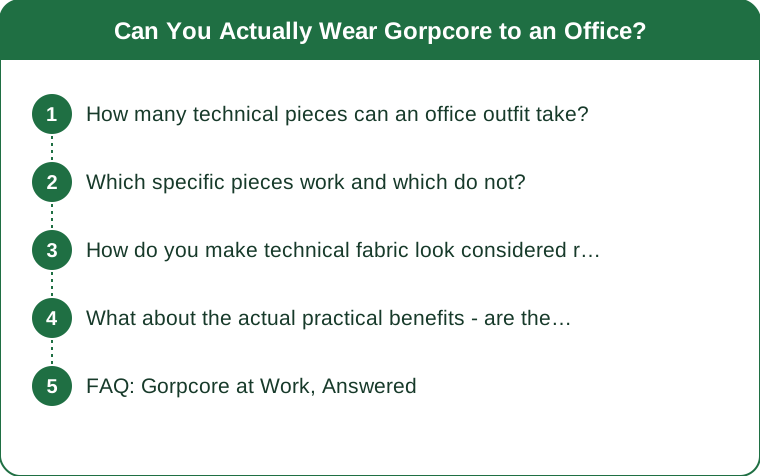
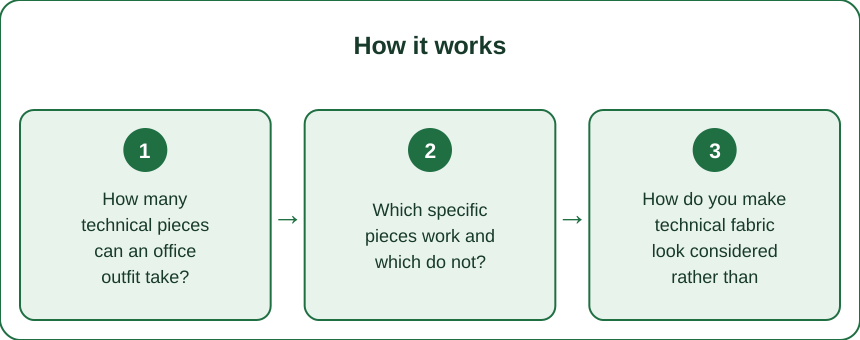
How many technical pieces can an office outfit take?
One, plus a bag. That is the practical ceiling for most workplaces, and it is a surprisingly reliable rule across quite different offices.
The reason is that technical fabric signals function loudly. One piece reads as a deliberate choice; two pieces read as an activity; three reads as a costume.
Outerwear is the piece to spend the technical budget on, because a coat is removed on arrival and is expected to be practical. Nobody has ever questioned a good shell in a lobby.
A fleece as a mid-layer is the second safest, particularly a plain half-zip in a muted colour under a coat, where it functions as a jumper does.
Everything else - trousers, shoes, bag, cap - should read as ordinary, which is what gives the technical piece room to be interesting rather than confusing.
The exception is a genuinely casual workplace, where two technical pieces is fine. Even then, three is where the look tips, and the tipping point is remarkably consistent.
Which specific pieces work and which do not?
Works: a clean-lined shell in a solid colour. No large logo, no contrast panelling across the chest, and a cut that is closer to a raincoat than to a ski jacket.
Works: a plain half-zip fleece in grey, navy, oatmeal, or black. Worn under a coat or over a shirt, it functions exactly as knitwear does.
Works: a technical trouser in a matte, non-shiny fabric with a straight or tapered leg and no visible cargo pockets. This is the borderline case that succeeds or fails on the fabric finish.
Breaks it: trail shoes. They are the single fastest way to move an outfit from considered to hiking, because the sole and the colour blocking are both unmistakable.
Breaks it: zip-off trousers, visible cargo pockets, and anything with a drawcord at the ankle. These are function signals with no fashion ambiguity at all.
Breaks it: large logos and technology branding across the chest or back. A discreet mark is fine; a fabric technology name in large text is sportswear.
And caps are context-dependent - fine in a creative office, wrong almost everywhere else, and removed indoors regardless.

How do you make technical fabric look considered rather than sporty?
Colour does most of the work. Earth tones, slate, charcoal, and muted greens read as design. Bright colour blocking and neon accents read as performance gear, which is the whole point outdoors and the problem indoors.
Keep one accent colour at most and keep it small - a zip pull, a lining, a small logo. This is the standard gorpcore colour formula and it happens to be exactly what an office tolerates.
Silhouette matters as much as fabric. A shell with a defined shoulder and a straight hem reads as outerwear; an oversized shell with a dropped shoulder and a hem drawcord reads as gear.
Pair technical with tailored rather than with casual. A shell over trousers and a knit works; a shell over joggers and a t-shirt is an entirely different outfit made of the same category of clothing.
Choose matte over shiny. High-shine technical fabric is the most difficult finish to make read as workwear, and matte versions of identical garments are considerably easier to place.
And let the shoes anchor it. Leather boots, clean minimal trainers, or loafers underneath a technical top half is the combination that holds the look together. The shoes are what tell people this was a choice.
What about the actual practical benefits - are they worth it?
The waterproofing is the genuine argument, and it is a good one. A proper shell in autumn outperforms a wool coat by a wide margin on a wet commute, and it packs down small enough to keep at a desk.
Breathability matters more than waterproofing for most commutes, because the common failure is arriving damp from the inside. A membrane with a decent breathability rating is worth the extra cost if you walk or cycle.
Packability is the underrated benefit. A shell that lives in a bag means you stop making weather decisions in the morning, which is most of what outerwear is for.
The weight advantage is real but oversold. A technical shell is lighter than a wool coat and warmer per gram, but it is also less warm in absolute terms without a mid-layer - which is why the fleece exists.
Technical fabric does hold odour more than natural fibres, particularly synthetics worn close to the body. This is a genuine drawback for anything worn as a mid-layer several days a week, and it needs washing more often than wool would.
And durability varies enormously with price in this category, more than in most clothing. A cheap shell delaminates within a couple of seasons; a good one lasts a decade, and this is one of the few areas where the cost-per-wear argument genuinely holds.
FAQ: Gorpcore at Work, Answered
Can you wear gorpcore to a corporate office?
Yes, limited to one technical piece plus a bag. Outerwear is the safest place to put it - a coat is removed on arrival and is expected to be practical. Two technical pieces reads as an activity, three as a costume.
What is the fastest way to make it look wrong?
Trail shoes. The sole profile and colour blocking are unmistakable, and they move an outfit from considered to hiking faster than any other single item.
Which colours work in an office?
Earth tones, slate, charcoal, and muted greens. Keep any accent colour small - a zip pull or lining. Bright colour blocking reads as performance gear indoors.
Can technical trousers work for work?
Only in a matte, non-shiny fabric with a straight or tapered leg and no visible cargo pockets. This is the borderline piece that succeeds or fails entirely on fabric finish.
Is a fleece office-appropriate?
A plain half-zip in grey, navy, oatmeal, or black works as knitwear does, particularly under a coat. Avoid high-pile fleece, large logos, and contrast panelling.
Is the technical performance actually worth it for commuting?
For a wet or active commute, yes - breathability matters more than waterproofing, and packability means you stop making weather decisions. Note that synthetics hold odour more than wool and need washing more often.
TL;DR:
- One technical piece plus a bag is the ceiling for most offices; two reads as an activity and three as a costume.
- Put the technical budget into outerwear - a coat is removed on arrival and expected to be practical.
- Trail shoes, zip-off trousers, visible cargo pockets, and large logos break it fastest.
- Muted colours, matte finishes, and a defined silhouette are what make technical fabric read as design.
- Pair technical with tailored rather than casual, and let leather boots or clean minimal trainers anchor it.
The rule is arithmetic: one loud piece, everything else quiet.
Keep Reading
This article is for general informational and styling purposes only. Fit, sizing, and product availability may vary.