How Do You Wear a Technical Shell Without Looking Like You Are Hiking?
Quick Answer: A shell reads as hiking gear when everything around it is also technical. Put it over natural fibres — wool, denim, corduroy, leather — and it immediately reads as outerwear rather than kit. Beyond that: choose a muted or single colour over contrast panelling, size it to fit over a knit rather than over a fleece and a mid-layer, and keep the footwear off the trail.
The shell is genuinely the best jacket for a British or north-eastern autumn. It is waterproof, it packs down, it is windproof and it weighs nothing.
It is also the one that makes people ask whether you are going somewhere. Here is what actually decides that, question by question.
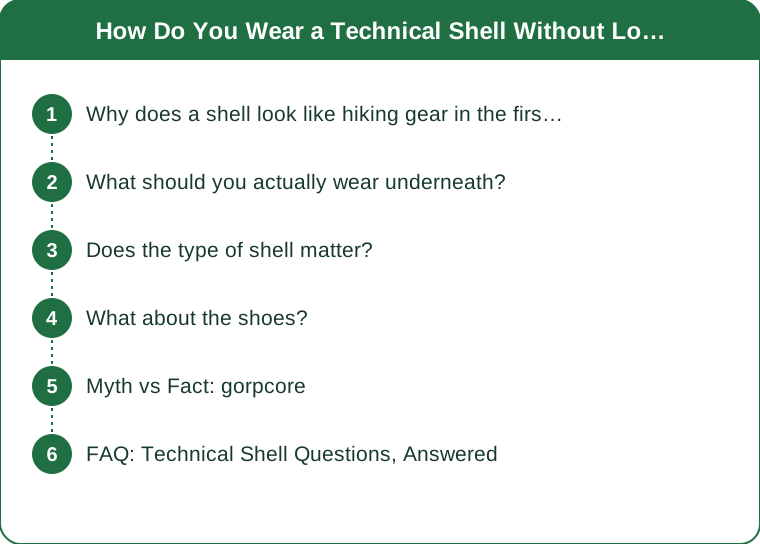
Why does a shell look like hiking gear in the first place?
Because of context, and context is almost entirely what is underneath it.
A technical shell has a set of visual signals: a smooth or slightly ripstop face fabric, taped seams, a hood with a wire brim or a volume adjuster, cord pulls, and often colour-blocked panels. Individually none of those reads as hiking. Collectively, and combined with other technical items, they read as a full kit.
The single strongest signal is fabric contrast, or the lack of it. A shell over a fleece over a technical baselayer, with trail shoes below, is four technical fabrics in a row and there is nothing in the outfit that is not performance kit. The eye reads the set, not the jacket.
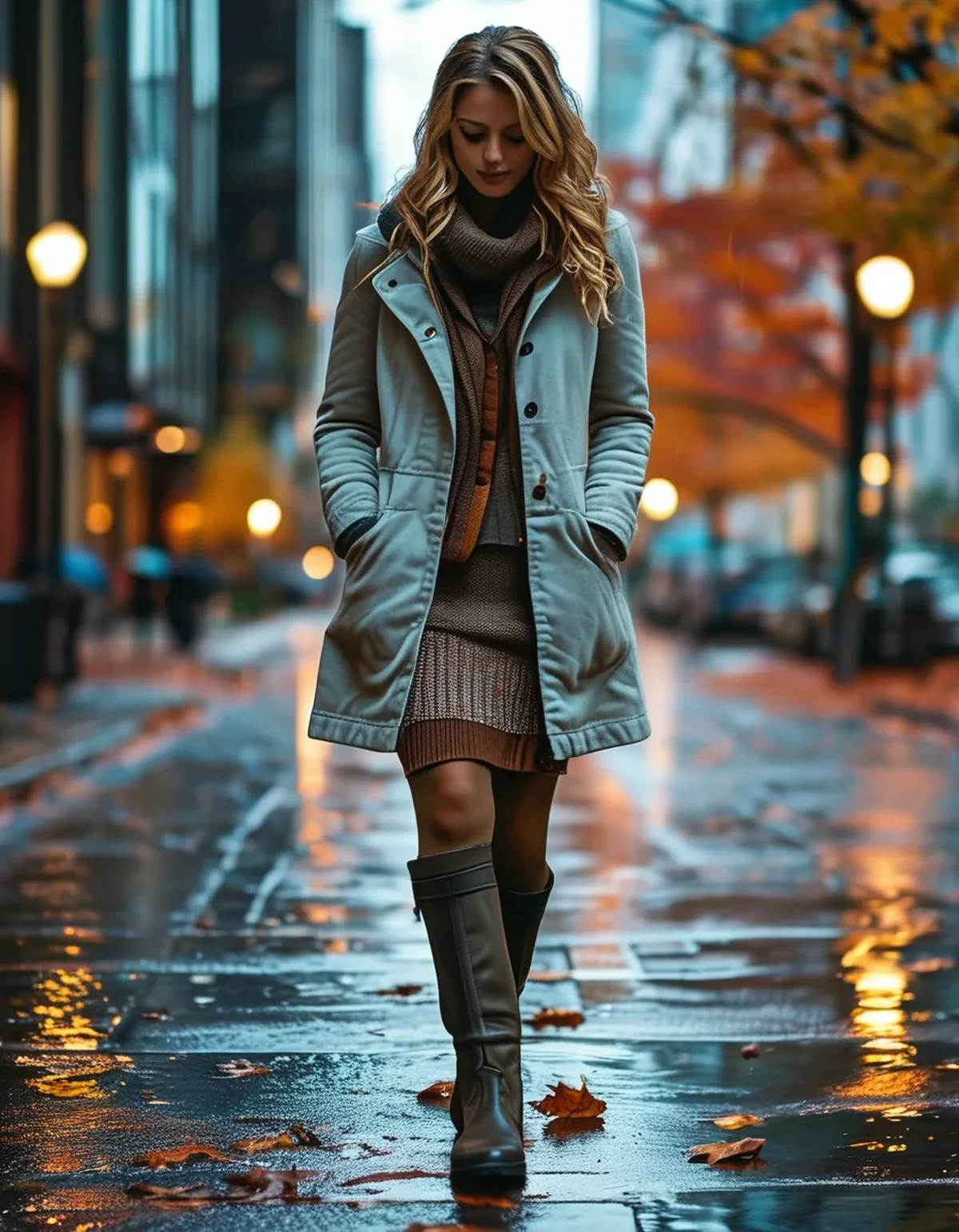
Put the same shell over a wool jumper, a corduroy trouser and a leather boot, and it becomes the one technical item in an outfit of natural materials. Now it reads as a raincoat — a good, expensive raincoat — because that is what a raincoat is.
The second-strongest signal is colour combination. High-contrast panelling in two saturated colours is a design language specific to performance outerwear. The same jacket shape in a single muted colour crosses over instantly, which is why almost every outdoor brand now sells a “lifestyle” colourway that is structurally identical to the trail version.
The third is fit. Shells are often bought a size up to layer over a mid-layer and a fleece, which produces a lot of volume through the body. Sized to fit over a jumper, the same jacket has a shape.
What should you actually wear underneath?
The rule that does all the work: one technical item per outfit, and everything else natural.
Wool knitwear. A chunky jumper or a fine merino roll-neck under a shell is the most reliable combination there is. The texture contrast between a matte knit and a smooth technical face is the whole point — it makes the shell look deliberate.
Denim, corduroy, wool trousers. Anything with visible weave and no stretch sheen. A straight or wide-leg jean under a shell is a complete outfit. Technical trousers under a technical shell is a kit.
A skirt, which is the underrated option. A wool midi or a pleated skirt with opaque tights and boots, under a shell, is a genuinely good autumn outfit and it is about as far from hiking as it is possible to get while wearing a waterproof.
Leather or suede somewhere. A bag, boots, or a belt. One piece of leather in the outfit anchors it firmly in the non-technical register.
What to avoid underneath: fleece, softshell, anything with a logo at the chest, and technical trousers in the same colour family as the jacket. Matching your shell to anything else you are wearing is what tips it over.
Does the type of shell matter?
Considerably. Some are much easier to wear than others, and it is mostly about silhouette and finish.
Easiest: a longer anorak or a hip-length shell in a matte finish, single colour. The length gives it coat proportions rather than jacket proportions, and matte fabric reads far less technical than a glossy face.
Also easy: the oversized boxy shell in a neutral. Cream, olive, stone, charcoal, navy. The volume is a fashion silhouette rather than a layering allowance, and it works over a slim base.
Harder: the fitted athletic-cut shell with a high collar and contrast panels. This is designed to look fast, and it looks fast in a city too. Wearable, but it needs everything else to be quite plain.
Hardest: anything with a large brand logo, contrast-colour zips, and reflective detailing. Reflective piping in particular is unambiguously performance-focused, and there is no styling route around it.
A note on hoods: a soft packable hood disappears when down. A wire-brimmed hood with a volume adjuster at the back sits proud of the collar and is visible in every photo. If you are buying a shell primarily for town, the hood construction matters more than any other feature.

What about the shoes?
Shoes decide it more than anything else below the waist, and this is where most otherwise good outfits go wrong.
Works: a leather ankle boot, a Chelsea boot, a clean leather trainer, a chunky loafer, a rubber-soled brogue. Anything with a leather upper and a definite shape.
Also works, carefully: a proper hiking boot in leather, if the rest of the outfit is emphatically not technical. A leather hiking boot with a wool skirt and a shell reads as considered; the same boot with technical trousers reads as a walk.
Does not work: trail running shoes. This is the single most common failure. Trail shoes have an unmistakable silhouette — aggressive lugs, a rockplate, bright accents, a mesh upper — and they pull the whole outfit onto a path. They are excellent shoes and they belong with the rest of the kit.
Also does not work: approach shoes and anything with a visible sticky-rubber climbing sole in a contrast colour.
The socks matter too, oddly. A thick technical sock visible above a boot is a strong signal. A ribbed wool sock is not.
Myth vs Fact: gorpcore
Myth: Gorpcore means dressing entirely in outdoor gear. Fact: The version that actually looks good is one or two technical pieces in an otherwise conventional outfit. Head-to-toe technical is not a style, it is a kit — perfectly correct on a hill and not a look in town.
Myth: It has to be an expensive brand to work. Fact: Silhouette, colour and finish decide how a shell reads, and none of those correlate strongly with price. A muted, well-cut cheap shell reads better in town than an expensive one in high-contrast panels.
Myth: A waterproof will always look bulky. Fact: Bulk comes from sizing up for layering. A shell sized to go over a jumper rather than over a fleece plus a mid-layer has a completely different shape, and modern three-layer fabrics are thin enough that the jacket itself adds almost nothing.
Myth: Technical fabrics are inherently unflattering. Fact: They are inherently shiny in some finishes, which is a different problem and a solvable one — matte and brushed face fabrics photograph and wear very differently from glossy ones.
Myth: You cannot wear a shell somewhere smart. Fact: A single-colour matte shell over tailoring is a standard commuting combination in every rainy city, and it looks entirely normal. Over a suit it is arguably more appropriate than a wool coat in heavy rain.
FAQ: Technical Shell Questions, Answered
What colour shell is most versatile?
Black, charcoal, olive, stone and navy in that order. A single muted colour with matching zips is the most wearable configuration. If you want colour, a single saturated colour is far easier to style than two colours blocked against each other.
Can I wear a shell over a blazer?
Yes, and it works well, but you need the length and the sleeve room. A hip-length or longer shell sized to accommodate a shoulder seam will do it; a fitted athletic-cut one will pull across the back.
Does it matter that I will never actually hike in it?
No. A good three-layer waterproof is the right jacket for autumn commuting whether or not it ever sees a hill, and it will outlast several wool coats. Buying performance gear for city use is an entirely reasonable thing to do.
How do I stop it rustling and looking cheap?
That is face-fabric denier and finish. Thin, high-denier ripstop is the crinkly one. Heavier, brushed or matte face fabrics are quieter and drape better — which is also why they look less technical. Handle it in person if you can.
TL;DR:
- A shell looks like hiking gear because of what surrounds it, not because of the jacket.
- One technical item per outfit; everything else in wool, denim, corduroy or leather.
- Choose muted single colours, matte face fabrics, a soft hood, and a size that fits over a jumper rather than a fleece.
- Shoes decide it: leather boots and clean trainers work, trail runners never do.
The most useful jacket you own does not have to announce itself. Put a wool jumper under it and it stops.
Keep Reading
This article is for general informational and styling purposes only. Fit, sizing, and product availability may vary.