Gorpcore, Explained: What It Means and How to Actually Wear It
Quick Answer: Gorpcore is the style of wearing genuine outdoor and hiking gear — shells, fleeces, trail shoes, technical fabrics — as everyday city clothing. The name comes from GORP, the American hiking term for trail mix (“good old raisins and peanuts”). The look works when the gear is real and the styling is restrained: one or two technical pieces against plain, well-fitting basics, in a muted palette. It stops working when every layer is technical at once.
If you have seen someone on a train platform in a proper mountain shell and trail runners with no mountain in sight, that is gorpcore.
Here is what it actually means, what to buy first, and the specific mistakes that make it read as costume.
What does gorpcore actually mean?
It is the adoption of real outdoor equipment as urban fashion, and the emphasis is on real.
GORP stands for good old raisins and peanuts — American hiker slang for trail mix. The suffix follows the pattern of normcore and cottagecore, so gorpcore literally means the aesthetic of trail-mix people: hikers, climbers, backpackers.
What distinguishes it from other outdoor-adjacent trends is that gorpcore uses functional gear rather than fashion imitations of it. The waterproof shell has taped seams and a real hood. The fleece is a proper grid fleece. The shoes have an aggressive outsole because they were designed to grip wet rock, not because a designer liked the look.
It is technically inherited, not stylistically invented. Most of the pieces are decades old as products. What changed is where they are worn — the shell that used to live in a rucksack now goes to the office and stays on.
And it is not the same as athleisure. Athleisure borrows from the gym: soft, stretchy, close to the body. Gorpcore borrows from the mountain: technical, weather-facing, often boxy and utilitarian. The two look nothing alike in person even though both are sportswear worn casually.
Is it spelled gorpcore or gorp core?
Both appear, but the single word is the standard form, matching the -core convention it borrows from.
Which pieces actually define it?
Five categories, and you need far fewer than people assume to get the look.
What is the single most defining piece?
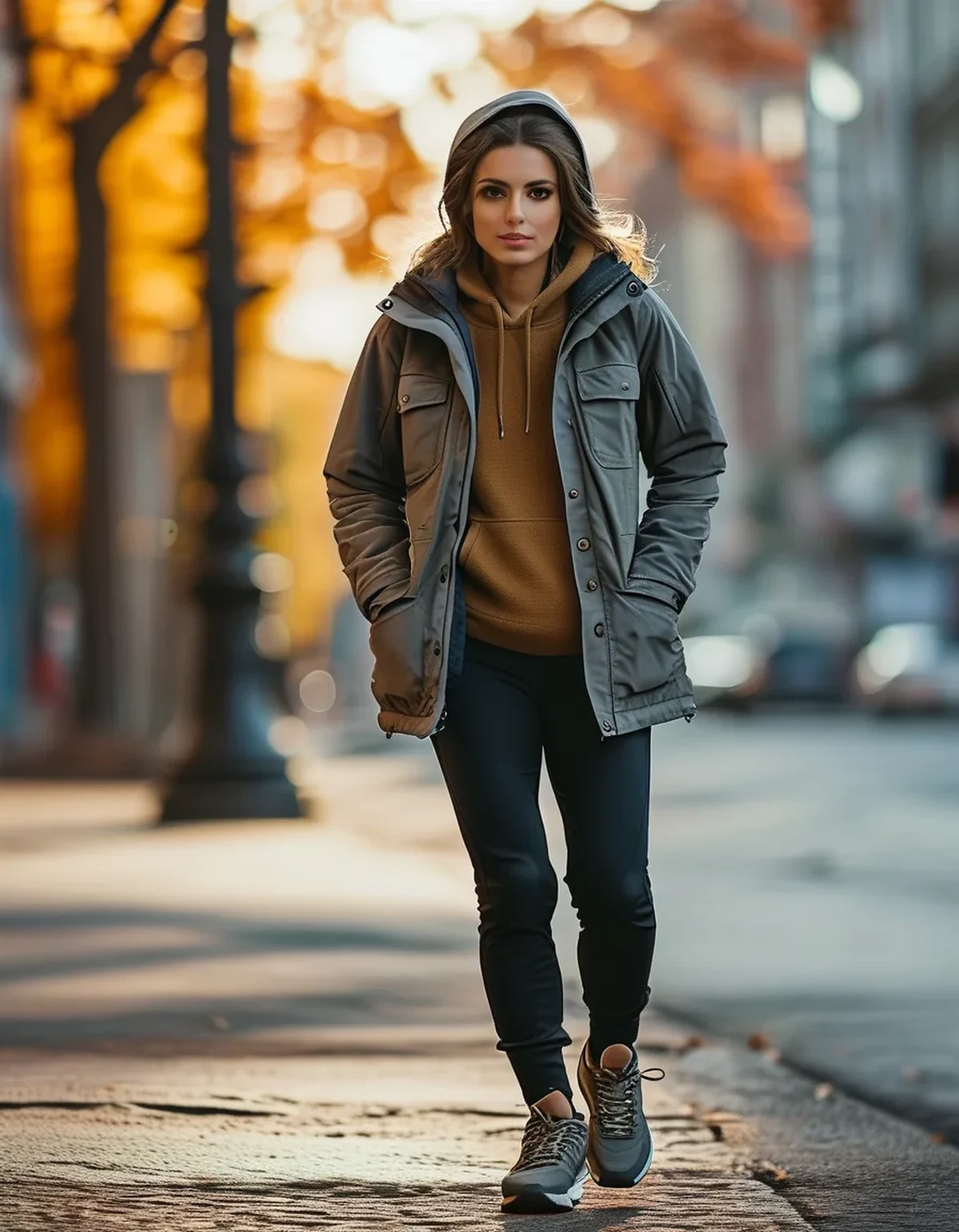
The technical shell — a waterproof, breathable hooded jacket. It is the most recognisable gorpcore item and the most genuinely useful. Look for taped seams, a hood that adjusts, pit zips and a hem drawcord. In the city, a slightly longer length is more wearable than a climbing-cut short hem.
The fleece. A grid fleece or a full-zip pile fleece is the second pillar, and in autumn it is the piece you will actually wear most. Fleece reads unmistakably outdoor while being comfortable enough for a desk.
The insulated vest or puffer. Sleeveless synthetic or down insulation over a fleece is a very legible gorpcore layer and it solves the real problem of a warm torso with mobile arms.
Technical trousers. Ripstop nylon, articulated knees, a gusseted crotch, zip pockets. These read more subtly than the jacket and are what makes an outfit look coherent rather than like one loud item over normal clothes.
Accessories carry more weight here than in most aesthetics. A carabiner, a technical beanie, a small crossbody or sling bag in ripstop, a webbing belt. One of these adds a great deal of the look for very little money.
Where should a beginner start?
A fleece, not a shell. It is cheaper, more wearable through autumn, works with clothes you already own, and does not commit you to the loudest version of the aesthetic on day one.

What about gorpcore shoes?
The shoes are where most people get it right or wrong, and there are three distinct families.
What counts as a gorpcore shoe?
Trail runners are the most versatile — a running shoe with a grippy lugged outsole and a protective toe. They are comfortable for daily wear, read clearly as outdoor without being heavy, and work with almost everything. If you buy one pair, buy these.
Approach shoes sit between a trainer and a climbing shoe, with a sticky rubber sole and a low profile. They are the most quietly credible option and the most comfortable for city walking on hard surfaces.
Hiking boots are the most visually committed. A mid-height boot with a technical outsole is unmistakably gorpcore, and it is also the easiest way to overdo it. Boots work best when the rest of the outfit is very plain.
Do the shoes have to be a specific colour?
No, and this is where the aesthetic gives you the most freedom. Outdoor gear has always used bold accent colours for visibility, so a single flash of orange, teal or acid green in the footwear is authentic rather than a fashion choice. A bright shoe with an otherwise muted outfit is one of the most reliable gorpcore combinations.
Are chunky fashion sneakers gorpcore?
Generally not. A shoe with a technical look but no technical function reads as an imitation to anyone familiar with the gear, and the aesthetic is unusually sensitive to that. Real outsoles are also simply better in wet weather, which is the season you are dressing for.
Can I wear the same shoes for actual hiking?
Trail runners and approach shoes, yes — that is what they are for. Bear in mind that city pavements wear lugs down much faster than trails do, so a pair used daily will lose grip well before it looks worn out.
How do you wear it without looking like you got lost?
One rule does most of the work, and then a handful of adjustments.
What is the single most important rule?
One or two technical pieces, not five. A shell over jeans and a plain jumper reads as good taste. A shell, over a fleece, over a base layer, with technical trousers, a hiking boot, a beanie and a carabiner reads as someone who took the wrong exit. Technical pieces need plain ones around them to be legible.
How should the fit work?
Outdoor gear is cut roomy because it is designed to layer over things. That volume is part of the appeal, but it needs balance — a boxy shell works over slim trousers; a boxy shell over wide technical trousers gives you no line at all. Pick one volume and keep the other close.
What about colour?
A muted base with one accent is the formula. Olive, charcoal, navy, black, stone and cream as the ground; one bright piece — usually the shoes, the beanie or a bag — as the accent. Two competing bright pieces is the most common colour mistake.
Does it work in an office?
The fleece and the vest do, particularly a fine-gauge fleece in a neutral colour over a shirt. A full technical shell with a helmet-compatible hood does not, and no amount of styling fixes that. The vest over a knit is the most office-viable version of the aesthetic.
Is gorpcore still right when the weather turns?
This is when it makes the most sense, and it is the aesthetic’s genuine advantage. Every piece was designed for cold, wind and rain, so from now through winter you are wearing the right thing for the actual conditions rather than a summer look adapted to them. Autumn is when gorpcore stops being a style choice and starts being simply correct.
Do I need expensive brands?
No. The aesthetic is defined by the type of garment, not the label — a mid-range shell with taped seams reads exactly the same on the street as a flagship one. Where money genuinely buys performance is waterproofing and breathability, which matters if you are outside in it and not if you are walking to a car.

FAQ: Gorpcore Questions, Answered
Is gorpcore over?
The name may fade, but the underlying behaviour — technical outerwear worn as everyday clothing — has been growing steadily for years and is not tied to a season. Buying real gear rather than trend pieces is what makes it durable in both senses.
What is the difference between gorpcore and just wearing outdoor clothes?
Intent and styling. Wearing a shell because it is raining is practical. Choosing the shell, the shoes and the palette to work together as an outfit in dry weather is the aesthetic.
Can I mix gorpcore with tailoring?
Yes, and it is one of the better-looking combinations — a technical shell over a wool trouser, or a fleece under a tailored coat. The contrast is the point, and it avoids the head-to-toe problem entirely.
Does the gear need to be new?
No. Secondhand outdoor gear is abundant, often barely used, and the older colourways from the 1990s are among the most sought after. Check that any waterproof has an intact face fabric and no delaminating inner layer.
Is it a men’s aesthetic?
No, though a lot of the imagery skews that way. The main practical issue is that outdoor gear is often cut for a straighter frame, so fit matters more — women’s-specific cuts in shells and fleeces are worth seeking out rather than sizing down a men’s piece.
What is the one thing to avoid?
Wearing every technical layer at once. Almost every gorpcore outfit that looks wrong is that one mistake, and almost every one that looks right has plain clothes doing most of the work.
TL;DR:
- Gorpcore = real outdoor gear worn in the city. The name comes from GORP, hiker slang for trail mix.
- The defining pieces are the technical shell, the fleece, the vest, ripstop trousers and a lugged-sole shoe.
- Trail runners are the best first shoe; approach shoes are the subtlest; boots are the easiest to overdo.
- Wear one or two technical pieces against plain basics. Head-to-toe technical is the mistake that makes it costume.
- Muted base, one bright accent — usually the shoes. It is not the same as athleisure.
Start with a fleece. It is the cheapest entry point, the most wearable through autumn, and it works with what you already own.
Keep Reading
This article is for general informational and styling purposes only. Fit, sizing, and product availability may vary.